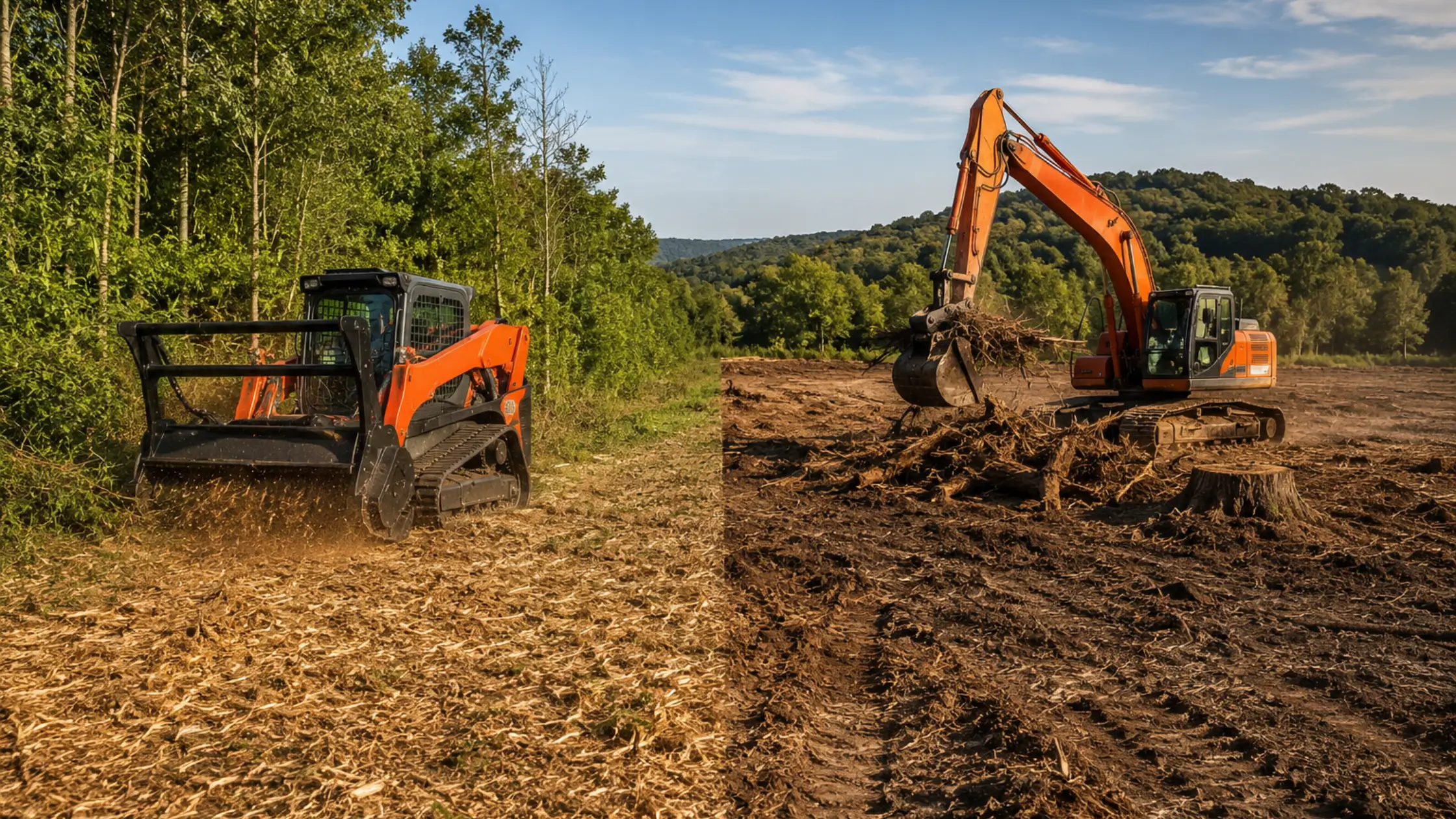
When a property needs vegetation removed, forestry mulching and traditional land clearing are not interchangeable services. Each method produces a different finished condition, affects the soil differently, and makes sense for different property goals.
Choosing between them starts with one question: What do you need the land to be used for after the vegetation is removed?
In Southern Indiana, that question matters because rolling terrain, seasonal rainfall, runoff, erosion, and variable soil conditions can influence how a clearing project affects the ground. A method that works well for managing an overgrown field may not be appropriate for a future building pad or driveway.
The right clearing method should match the property’s end use while protecting soil stability and managing water movement over the long term.
Quick Answer: Forestry Mulching vs. Land Clearing
Forestry mulching is usually the better fit when the goal is vegetation management, access, trails, pasture improvement, or reclaiming overgrown land without completely stripping the site. Traditional land clearing is generally the better choice when the property needs bare, graded, and potentially compacted ground for construction or other structural use.
- Forestry mulching: Vegetation is ground into mulch and left on the site.
- Traditional land clearing: Vegetation, stumps, and root systems are removed to create a more completely cleared surface.
- Cost: Forestry mulching is often less expensive because it can reduce hauling, disposal, and separate stump removal.
- Timeline: Forestry mulching is commonly faster because vegetation can be processed in place.
- Construction: Building pads, driveways, and other structural improvements usually require more complete clearing and site preparation.
- Best approach: Some properties benefit from using both methods in different areas.
What Forestry Mulching Actually Does
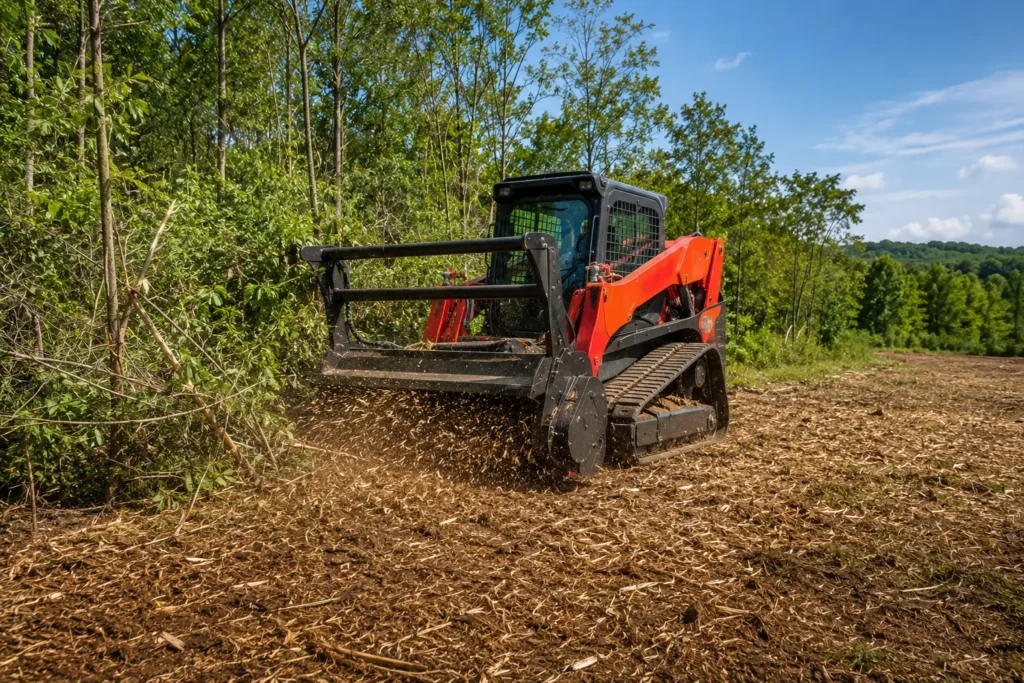
Forestry mulching uses specialized equipment to cut and grind brush, saplings, small trees, and other vegetation into mulch directly on the property. Instead of creating large debris piles that must be hauled away, the processed material remains on the ground.
That difference matters because the finished surface retains ground cover and the existing root structure remains in place. The result can be useful for property owners who want to improve access, reclaim overgrown land, manage vegetation, or establish trails without completely disturbing the soil.
The mulch layer can also help reduce exposed soil and support erosion control. The USDA Natural Resources Conservation Service recognizes mulching as a conservation practice that can reduce erosion and help manage moisture.
For a closer look at how this method works locally, see our guide to forestry mulching in Bloomington.
What Forestry Mulching Does Not Do
Forestry mulching does not automatically create construction ready ground.
Because root systems and some organic material remain in place, the finished surface is different from a site that has been fully cleared, excavated, graded, and compacted for structural use. If a building, driveway, utility corridor, or other improvement requires a specific subgrade, additional excavation and preparation may be necessary.
That distinction prevents a common mistake: treating vegetation removal as the same thing as site preparation.
What Traditional Land Clearing Actually Does
Traditional land clearing is a more complete removal process. Depending on the project, equipment is used to remove trees, brush, stumps, and root systems, followed by debris management and site preparation.
The goal is often to create a cleaner, more open surface that can then be graded for its intended use.
This method makes more sense when the property will be developed, built on, or reshaped. Removing vegetation and root systems can be necessary before establishing a stable subgrade for a building pad, driveway, utility installation, or other construction work.
The tradeoff is greater site disturbance and potentially more work associated with stump removal, debris handling, grading, and stabilization.
Forestry Mulching vs. Traditional Land Clearing: Cost Comparison
Forestry mulching is often less expensive per acre when the property only needs vegetation reduced and does not require complete debris removal.
The reason is straightforward. A mulcher can process vegetation on site, which can reduce the number of separate steps involved in cutting, loading, hauling, and disposing of material.
Traditional land clearing can cost more because the project may require:
- Stump and root removal
- Additional equipment and labor
- Debris handling or hauling
- More extensive grading
- Soil stabilization after disturbance
- Additional preparation for construction
However, there is no reliable one size fits all price for either method. Vegetation density, acreage, terrain, access, tree size, stump conditions, and the required finished grade can all change project costs.
A site evaluation is more useful than a generic per acre number because it identifies what the property actually needs.
Forestry Mulching vs. Traditional Land Clearing: Timeline Comparison
Forestry mulching is often faster when the objective is vegetation reduction rather than complete site preparation.
The equipment can process vegetation in place, reducing the need for separate removal and hauling stages. This can make the project more efficient when the finished land does not need to be completely bare.
Traditional clearing generally involves more steps. Depending on the property, the sequence may include vegetation removal, stump and root removal, debris management, grading, compaction, and stabilization.
The longer process is justified when those additional steps are necessary for the property’s next use. Saving time on clearing does not help if the site later has to be cleared again or reworked for construction.
Comparison Table
| Factor | Forestry Mulching | Traditional Land Clearing |
|---|---|---|
| Primary purpose | Vegetation and land management | Complete clearing and site preparation |
| Finished surface | Mulch remains on site | More completely cleared surface |
| Root systems | Generally remain in place | Removed when required by project |
| Debris hauling | Usually reduced | More likely to be required |
| Soil disturbance | Generally lower | Generally higher |
| Typical timeline | Often faster | Usually more involved |
| Construction preparation | May require additional work | Better suited to full site preparation |
| Erosion considerations | Ground cover can help protect exposed soil | Requires careful stabilization after disturbance |
| Best use | Trails, pasture, managed land, access, overgrowth | Building pads, driveways, development, structural site work |
When Forestry Mulching Is the Right Choice
Forestry mulching is often a good fit when the property owner wants to manage vegetation without completely rebuilding the site.
It can make sense for:
- Overgrown fields and acreage
- Pasture reclamation
- Trails and access paths
- Property maintenance
- Buffer areas
- Small tree and brush reduction
- Invasive vegetation management
- Land that does not need a construction grade
The long term benefit is that the property becomes more usable without automatically creating the level of soil disturbance associated with full clearing.
For additional information, see our article on how brush clearing can transform your property in Southern Indiana.
When Traditional Land Clearing Is the Right Choice
Traditional land clearing is generally more appropriate when vegetation removal is only the first step toward another construction or site development activity.
It may be needed when:
- A building pad will be constructed
- A driveway requires a prepared subgrade
- Stumps and roots must be removed
- The final grade must be established precisely
- Soil needs to be compacted for structural use
- Utilities or other site improvements require a cleared corridor
- Large trees or dense vegetation cannot simply be mulched in place
The important point is that clearing should be planned around the finished use of the property. Removing vegetation without considering grading and drainage can create a new problem instead of solving the original one.
Why Some Properties Need Both Methods
Not every acre of a property needs the same treatment.
A property may use forestry mulching in areas that will remain wooded, managed, or recreational while using traditional clearing only where construction will occur. This can reduce unnecessary disturbance and avoid paying to prepare areas that do not need a construction ready surface.
For example, a future building area may require complete clearing, grading, and compaction while a surrounding buffer can remain under managed vegetation with selective mulching.
This approach matters because the goal is not to clear as much land as possible. The goal is to prepare each area for its intended use while maintaining stable soil and predictable water movement.
Why This Matters in Southern Indiana
Southern Indiana properties commonly include rolling terrain, wooded areas, changing elevations, and soils that can behave differently depending on moisture and site conditions. When vegetation is removed, the way water moves across the exposed ground can change.
That makes erosion and runoff planning an important part of clearing work.
Indiana DNR forestry guidance emphasizes minimizing soil disturbance and rutting and maintaining measures that manage runoff and erosion. USDA NRCS guidance also identifies soil cover and erosion control as important components of land management in Indiana.
On sloped ground, removing vegetation without considering where runoff will travel can expose soil to concentrated water flow. On a future construction site, the issue is different but equally important: the cleared ground may need to be shaped, compacted, and stabilized so it can support the next stage of development.
The clearing method should therefore be selected with the site’s drainage, slope, soil conditions, and final use in mind.
Common Mistakes When Choosing a Clearing Method
Choosing Based Only on Price
A lower initial clearing price is not necessarily the lower total project cost.
If a property eventually needs stumps removed, additional grading, debris hauling, or subgrade preparation, choosing a method that does not match the end use can create extra work later.
Assuming Mulching Means Construction Ready
Forestry mulching can create clean, usable land, but it does not automatically produce the engineered surface required for a building pad or other structural improvement.
Clearing the Entire Property to the Same Standard
Some areas may need complete clearing while others only need vegetation management. Treating the entire property the same way can create unnecessary disturbance and cost.
Ignoring Water Movement
Clearing changes the surface conditions of a property. If runoff is not considered, disturbed or exposed soil can become vulnerable to erosion, especially on slopes.
Removing Vegetation Without Planning the Next Step
Clearing should be connected to what comes next. If the site will be graded, drained, excavated, or developed, the clearing plan should support those activities rather than treating vegetation removal as a standalone task.
Why Engineering Led Approach Is Different
Alchemy Excavation evaluates clearing based on the property’s intended use, existing conditions, and the work that needs to happen after vegetation removal.
Because the company combines excavation, land management, and engineering experience, the recommendation can account for more than vegetation density. The evaluation can consider access, slope, drainage, grading requirements, soil disturbance, and the intended finished condition.
That matters when a property needs more than a visually clear surface.
The goal is to select the method that supports long term land performance rather than automatically recommending the fastest or most extensive clearing option.
How We Evaluate Which Method Fits
A practical evaluation starts with the finished goal and works backward.
- Identify the intended use. Determine whether the land is for recreation, pasture, access, property management, construction, or another purpose.
- Review existing conditions. Consider vegetation density, tree size, terrain, access, slope, and visible drainage patterns.
- Determine the required finished surface. Establish whether the property needs managed ground cover or a bare, graded, and compacted surface.
- Plan drainage and erosion control. Identify how water currently moves and how clearing may change runoff.
- Select the clearing method. Use forestry mulching, traditional clearing, or a combination based on the actual site requirements.
- Plan the next stage. If construction, grading, drainage, or utility work follows, coordinate clearing with that work so the site does not need to be disturbed twice.
Not sure whether your property needs forestry mulching, traditional land clearing, or a combination of both?
Alchemy Excavation can evaluate the property based on its intended use, existing conditions, drainage, and the finished result you need. The goal is a practical clearing plan that prepares the land correctly without unnecessary disturbance or work.
Free estimates are available throughout Southern Indiana.
Frequently Asked Questions
Is forestry mulching cheaper than traditional land clearing?
It is often less expensive when the property only needs vegetation management because the process can reduce separate hauling and stump removal steps. Actual cost depends on vegetation density, terrain, access, acreage, and the finished condition required.
Can I build on land that has only been forestry mulched?
Not necessarily. Forestry mulching leaves root systems and organic material in place, so additional clearing, excavation, grading, and compaction may be required before construction.
Does forestry mulching help with erosion?
It can help reduce exposed soil by leaving processed vegetation on the surface. However, erosion control still depends on site conditions, slope, runoff patterns, and how the project is performed.
Which method is better for a driveway?
If the driveway only needs a vegetation corridor, forestry mulching may help with initial access. If the driveway requires a prepared subgrade, drainage improvements, grading, and compaction, more complete clearing and site preparation may be necessary.
Is traditional land clearing always better for construction?
For construction areas, complete clearing is often more appropriate because roots, stumps, and organic material may need to be removed before grading and compaction. The exact scope depends on the design and site conditions.