A driveway culvert installation has a simple but important job. It allows water moving through a roadside ditch to pass underneath your driveway instead of backing up against the driveway entrance.
Because most of the pipe is underground, culvert problems can develop without being obvious at first. By the time you see a sagging driveway, significant erosion, or water consistently pooling beside the entrance, the underlying problem may have already affected the pipe, surrounding soil, or driveway structure.
This matters in Southern Indiana because seasonal rainfall, rolling terrain, clay heavy soils, and concentrated runoff can put significant pressure on drainage crossings. A culvert that is undersized, improperly installed, blocked, or deteriorated can affect much more than water flow. It can contribute to erosion, driveway settlement, washouts, and repeated drainage problems.
Understanding the early signs of a failing driveway culvert can help property owners address the problem before a drainage issue becomes a larger excavation and driveway repair.
How Do You Know if a Driveway Culvert Is Failing?
A failing driveway culvert often shows up through changes in water movement, the driveway surface, or the soil around the pipe.
Common warning signs include:
- Water repeatedly pooling or backing up beside the driveway after rainfall
- A driveway surface that begins to sag or dip over the culvert
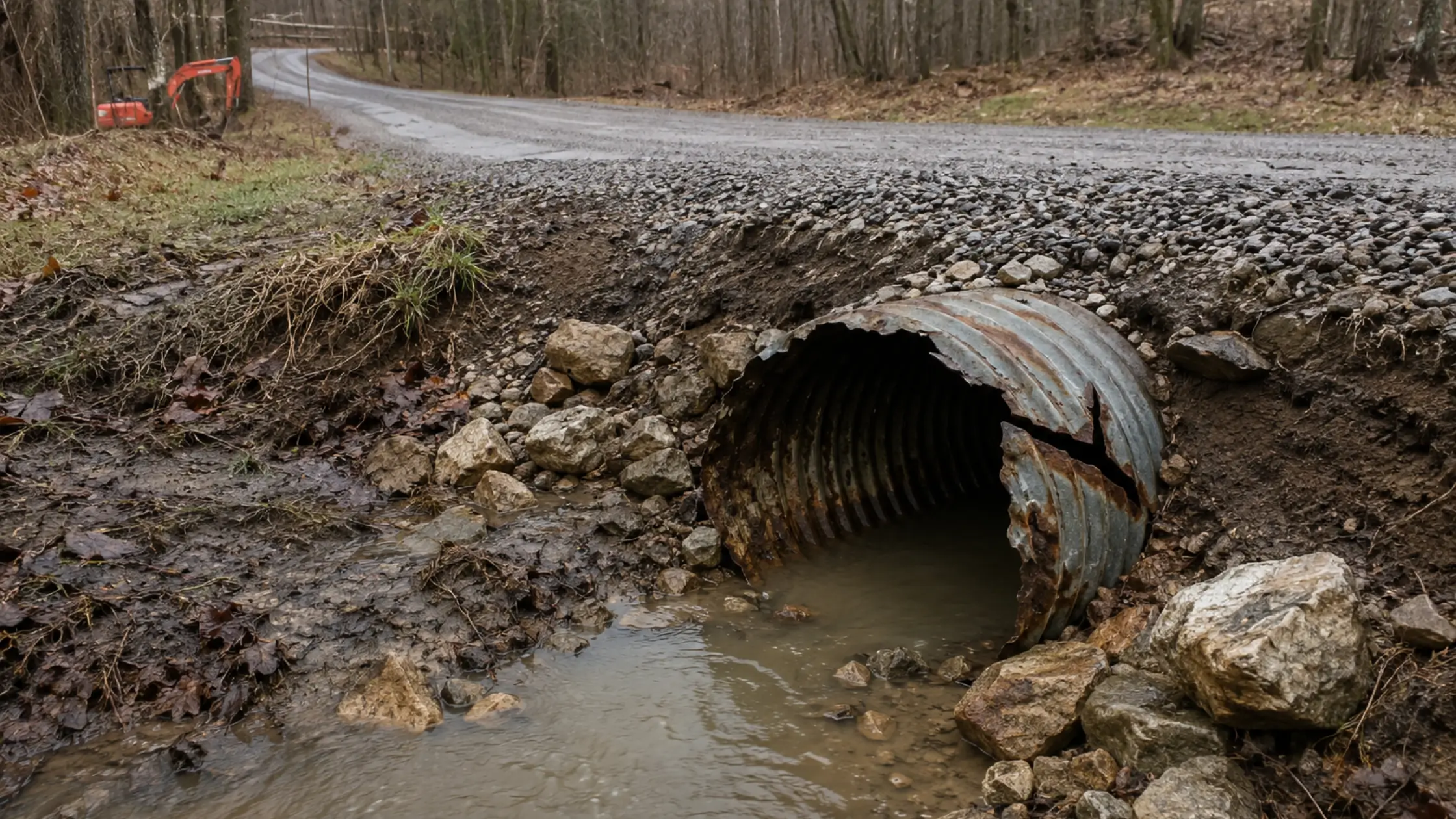
- Rust holes, cracking, crushing, or deformation at exposed pipe ends
- Soil erosion or washout around the inlet or outlet
- Repeated driveway washouts even after previous repairs
- Water flowing around the pipe instead of through it
These signs matter because they can indicate more than a clogged pipe. They may point to structural deterioration, improper elevation, inadequate sizing, poor ditch grading, or erosion around the culvert.
What Does a Driveway Culvert Actually Do?
A driveway culvert is a pipe installed beneath a driveway where the driveway crosses a drainage ditch or other water flow path.
Its purpose is to allow water to continue moving through the drainage system without being blocked by the driveway.
A properly functioning culvert depends on several factors:
- Appropriate pipe size
- Correct elevation
- Suitable slope
- Stable bedding
- Proper backfill and compaction
- Adequate inlet and outlet conditions
- A functioning upstream and downstream drainage path
The pipe itself is only one part of the system.
If the ditch is poorly graded or the pipe is too small for the water reaching it, simply replacing the pipe may not correct the underlying problem. Water may continue to back up, overflow, or erode the surrounding soil.
That is why culvert problems should be evaluated as drainage problems rather than treated as a simple pipe replacement.
6 Signs Your Driveway Culvert May Be Failing
1. Water Pools or Backs Up Beside the Driveway
One of the first visible signs of a culvert problem is water that repeatedly collects on one side of the driveway after rain.
A properly functioning culvert should allow water from the ditch to pass beneath the driveway. If water begins backing up, possible causes include:
- A blocked pipe
- A crushed or collapsed section
- An undersized culvert
- Improper pipe elevation
- Poor ditch grading
- Sediment buildup
- Restricted flow downstream
This matters because repeated standing water can keep surrounding soil saturated. Saturated soil has less ability to support the driveway and can contribute to erosion and settlement over time.
2. The Driveway Starts Sagging or Dipping
A sag or dip directly above a culvert deserves particular attention.
If the pipe has deteriorated, collapsed, or lost adequate support, the soil above it can settle into the void created by the failed structure. Repeated vehicle traffic can make the problem worse.
A driveway depression may therefore indicate a structural culvert problem rather than a simple surface issue.
Adding more gravel to the low area may temporarily improve the appearance, but it does not correct a failing pipe underneath.
Long term correction requires determining why the soil is settling and whether the culvert itself remains structurally sound.
3. The Pipe End Shows Rust, Cracking, or Deformation
The exposed ends of a driveway culvert provide an opportunity to inspect the pipe before a larger portion of the system becomes inaccessible.
Warning signs can include:
- Rust holes in metal pipe
- Cracks in concrete pipe
- Flattened or distorted pipe
- Broken sections
- Separation at joints
- Missing or deteriorated sections around the pipe opening
Visible deterioration does not automatically mean the entire culvert must be replaced. The extent of the damage and the condition of the buried section should be evaluated before determining the appropriate repair.
However, significant rust through, crushing, or structural deformation can indicate that replacement is becoming necessary.
4. Soil Is Eroding Around the Pipe Ends
Erosion around the inlet or outlet is another important warning sign.
Water should generally move through the culvert rather than escaping around the outside of the pipe. If soil is washing away beside or underneath the pipe, water may be finding an unintended flow path.
This can happen because of:
- Gaps around the pipe
- Poor compaction
- Pipe movement
- Settling
- Excessive flow
- An undersized pipe
- Inadequate outlet protection
Small areas of erosion can become larger washouts because the developing channel gives future runoff an easier path.
Correcting the pipe without addressing the water flow and surrounding soil can allow the same problem to return.
5. Your Driveway Keeps Washing Out
Repeated driveway washouts are often treated as a gravel problem, but the underlying issue may be drainage.
If water crosses the driveway surface instead of passing beneath it, every significant rainfall event can remove aggregate and weaken the driveway base.
A properly functioning culvert should help maintain the intended drainage path beneath the driveway.
When washouts continue after repeated surface repairs, the culvert, ditch grade, driveway elevation, and surrounding drainage should be evaluated together.
6. The Culvert No Longer Handles Water During Heavy Rain
A culvert can appear to work during normal rainfall and still be inadequate during heavier storms.
If water regularly reaches the top of the ditch, overtops the driveway entrance, or backs up around the pipe during significant rainfall, the drainage system may not have sufficient capacity.
The issue may involve pipe size, ditch geometry, upstream drainage area, slope, or downstream restrictions.
This is important because a culvert should be evaluated based on how the drainage system behaves, not just whether water passes through it during a light rain.
Culvert Repair vs. Culvert Replacement
Not every drainage problem requires a complete culvert replacement.
The appropriate solution depends on the condition of the pipe and the cause of the drainage problem.
| Condition | Possible Approach | Why It Matters |
|---|---|---|
| Minor blockage | Cleaning or clearing | Restores flow when the pipe itself remains structurally sound |
| Localized erosion | Stabilization and drainage correction | Prevents water from continuing to remove surrounding soil |
| Poor ditch grade | Ditch regrading | Restores the drainage path so water can reach the culvert |
| Undersized pipe | Culvert replacement or upgrade | Provides adequate capacity for the drainage area |
| Significant rust through | Culvert replacement | Restores structural integrity |
| Crushed or collapsed pipe | Culvert replacement | Restores the blocked drainage crossing |
| Driveway settlement over pipe | Structural evaluation and possible replacement | Prevents continued settlement and surface failure |
The goal should not be to replace a pipe simply because it is old. The goal is to determine why the culvert is failing and select a solution that restores reliable water movement.
Why Culvert Problems Rarely Stay Small
A culvert problem can affect several parts of a property at the same time.
A blocked pipe can cause water to back up.
Backed up water can saturate surrounding soil.
Saturated soil can weaken the driveway support.
Weakened support can contribute to settlement.
Settlement and continued runoff can create additional erosion.
That chain is why early evaluation matters.
A small drainage problem is generally easier to address than a failed culvert combined with driveway reconstruction, significant erosion, and unstable surrounding soil.
The long term objective is not simply to make the water disappear temporarily. It is to restore a drainage path that works with the property’s existing grades and runoff patterns.
You can also check Why Clay Soil in Southern Indiana Makes Drainage Planning Different
Why Culvert Installation Matters in Southern Indiana
Southern Indiana properties can present challenging drainage conditions because terrain, soil, and rainfall interact differently from property to property.
Rolling terrain can concentrate runoff into roadside ditches and low areas. Clay heavy soils can reduce infiltration and increase surface runoff during wet conditions. Seasonal rainfall can then place additional demand on drainage crossings.
These conditions make culvert sizing, elevation, slope, and surrounding grading important.
A culvert that works adequately on one property may not be appropriate for another because the contributing drainage area, ditch configuration, soil conditions, and downstream outlet are different.
This is particularly important when a driveway crosses an established drainage ditch. The goal is to allow water to continue following an appropriate drainage path without causing erosion or flooding at the driveway.
The Indiana Department of Transportation provides drainage and driveway guidance that considers existing and proposed drainage patterns, soil conditions, grades, runoff, and culvert analysis for applicable state roadway projects.
For properties affected by state roadway right of way, current requirements should be verified with the appropriate jurisdiction rather than assuming that a standard pipe size or installation method applies.
Common Culvert Installation Mistakes
Installing a Pipe Without Evaluating the Drainage Area
A culvert should not be selected based only on the width of the driveway.
The amount of water reaching the crossing matters because an undersized pipe can restrict flow and cause water to back up or overtop the driveway.
Using the Same Pipe Size Everywhere
There is no universal culvert size that works for every property.
Drainage area, ditch dimensions, slope, runoff, and downstream conditions all affect performance.
Installing the Pipe at the Wrong Elevation
A culvert can be large enough and still perform poorly if its elevation does not work with the existing ditch.
If the pipe sits too high, water can remain trapped upstream. If it is installed incorrectly relative to the ditch and downstream outlet, flow and erosion problems can develop.
Ignoring the Inlet and Outlet
The pipe is only part of the drainage system.
If water enters poorly or leaves the pipe at an unstable outlet, erosion can develop around the crossing even when the pipe itself is functioning.
Adding Gravel Instead of Addressing the Drainage Problem
Adding gravel over a failing driveway can hide the symptom without correcting the cause.
If water is undermining the driveway because of a failing culvert, additional aggregate does not restore the drainage path underneath.
Replacing the Culvert Without Correcting the Ditch
A new pipe can still fail to solve the problem if the ditch feeding it remains blocked, improperly graded, or unable to carry the expected flow.
The drainage system should be evaluated as a whole.
Permits and Right of Way Considerations
Culvert work is not always a simple private property project.
If a driveway connects to a state maintained roadway or the work affects public right of way, permit and drainage requirements may apply. INDOT states that driveway permits are required for connections to INDOT controlled roadways, and its guidance includes drainage considerations for driveway approaches.
Indiana guidance also recognizes that culverts under private and commercial driveways are generally the property owner’s responsibility.
Local requirements can differ for county roads and city streets, so property owners should verify which agency has jurisdiction before beginning work.
For drainage projects involving permitting, the INDOT permit resources provide current state guidance. The Indiana Drainage Handbook also provides information about drainage improvement planning and permitting considerations.
Why an Engineering-Led Approach Is Different
A culvert is not simply a pipe placed beneath a driveway.
Its performance depends on how water approaches the crossing, passes through the pipe, and leaves the system.
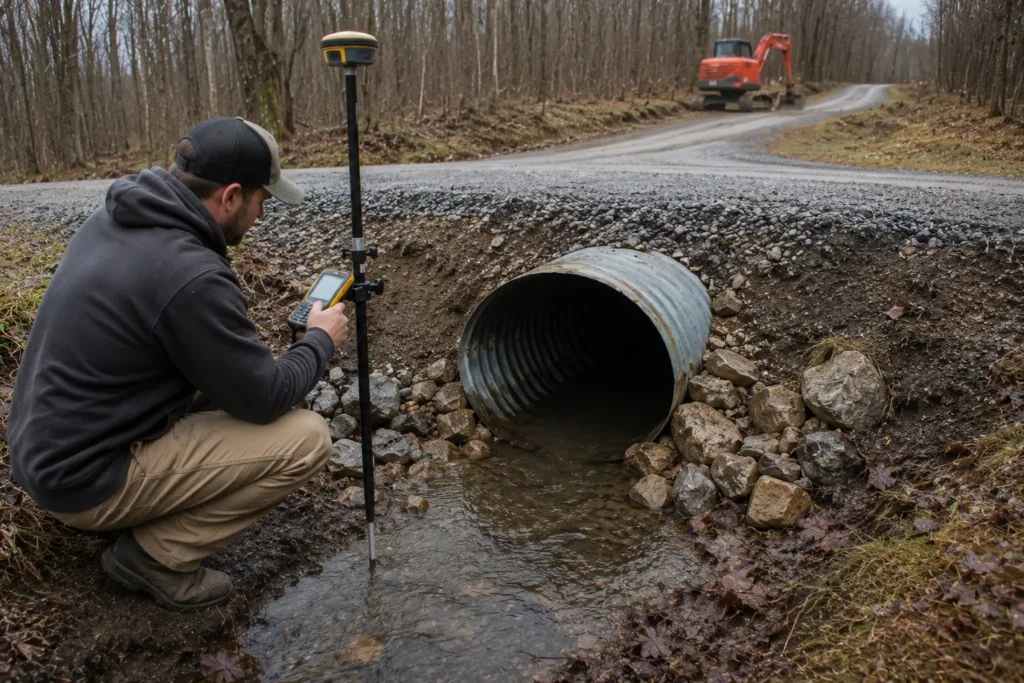
Alchemy Excavation approaches culvert projects by evaluating the drainage conditions around the crossing rather than focusing only on the pipe itself.
Evaluate the Existing Conditions
The first step is understanding the driveway, ditch, pipe, grades, soil, erosion, and water flow.
This helps determine whether the problem is caused by the pipe or by another part of the drainage system.
Determine the Appropriate Solution
Depending on the site, the solution may involve cleaning, grading, stabilization, repair, or complete replacement.
This prevents unnecessary work while addressing the actual cause of the problem.
Plan for Long Term Stability
Proper bedding, backfill, compaction, grading, and erosion control help protect the culvert and driveway from settlement and washout.
Consider Compliance
Where work affects public right of way or regulated drainage infrastructure, the project should account for applicable jurisdictional requirements.
The result should be a drainage crossing that supports the driveway while allowing water to move safely through the property.
For broader drainage problems, Alchemy also provides Culvert and drainage improvement services rather than treating the pipe as an isolated component.
Request a Culvert Evaluation
If your driveway has standing water, a sagging surface, erosion around the pipe, repeated washouts, or visible culvert damage, the first step is determining what is causing the drainage problem.
Alchemy Excavation provides engineering-led excavation and drainage solutions throughout Southern Indiana, including Bloomington, Bedford, Springville, Ellettsville, Mitchell, Seymour, Martinsville, Bargersville, Greenwood, and surrounding communities.
We evaluate the existing drainage conditions, identify the cause of the problem, and recommend a practical solution based on how water needs to move through the property.
Free estimates. No fluff. Real results.
FAQs About Failing Driveway Culverts
How do I know if my culvert needs repair or complete replacement?
Minor blockages, localized erosion, or drainage restrictions may sometimes be corrected without replacing the pipe. Significant rust through, crushing, deformation, or collapse may require replacement. A site evaluation is the best way to determine which approach is appropriate.
How long does a driveway culvert last?
Service life depends on pipe material, installation quality, soil conditions, drainage conditions, and maintenance. Corrugated metal, concrete, and plastic pipe can have different service lives, so age alone does not determine whether replacement is necessary.
What size culvert do I need for my driveway?
There is no single size that works for every driveway. Culvert sizing depends on factors such as drainage area, ditch configuration, slope, expected runoff, and downstream conditions.
Can a failing culvert cause driveway settlement?
Yes. If a pipe collapses, deteriorates, or loses surrounding soil support, the driveway surface above it can settle or dip. Continued vehicle traffic can make the depression worse.
Do I need a permit to replace a driveway culvert?
Permit requirements depend on the location and jurisdiction. Work involving a driveway connection to an INDOT controlled roadway can require a driveway permit, while county and city road requirements may differ. Always verify requirements before beginning work.
Can I repair the culvert without replacing it?
Sometimes. If the pipe remains structurally sound, clearing a blockage, correcting ditch grading, improving erosion protection, or addressing surrounding drainage may resolve the problem. If the pipe is structurally compromised, replacement may be necessary.
What happens if I ignore a failing culvert?
A small drainage problem can develop into driveway settlement, erosion, washout, pipe collapse, or repeated flooding. Addressing the underlying drainage problem earlier can reduce the potential for more extensive repairs later.