Clay Soil Changes Everything About Drainage
Standing water is one of the most common reasons property owners call us, but the solution is rarely the same from one property to another.
Throughout Southern Indiana, including Monroe, Lawrence, Jackson, Morgan, Brown, Greene, and surrounding counties, many properties sit on heavy clay soil. Unlike sandy soil, clay slows water movement, traps moisture, and changes how grading and drainage systems perform.
That means a drainage solution that works well in one yard may fail on another simply because the soil behaves differently.
At Alchemy Excavation, every drainage recommendation begins with understanding how water moves across your property, not with installing the same system everywhere.
Why Clay Soil Behaves Differently
Clay is made up of extremely small soil particles packed tightly together.
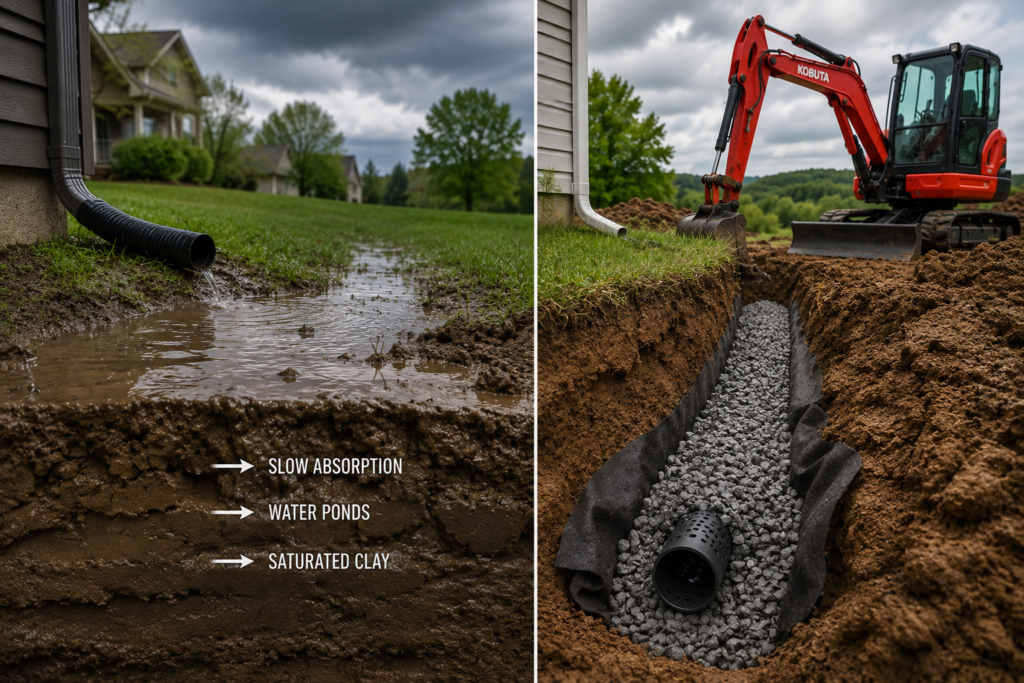
Because there is very little space between those particles, water cannot move through the ground quickly. Instead of soaking into the soil, rainfall often remains near the surface where it begins to pool.
This creates several challenges:
- Water remains on the surface much longer
- Runoff follows low areas across the property
- Soil stays saturated after storms
- Foundations experience more moisture exposure
- Driveways and building pads remain soft longer
Understanding these characteristics is important because drainage systems must be designed around the way the soil naturally behaves. Even a properly installed French drain can underperform if water cannot reach the pipe fast enough. Learn more about our French Drains & Yard Drainage services and how they are designed around your property’s soil conditions.
You can also review your property’s soil characteristics using the USDA Natural Resources Conservation Service Web Soil Survey, which provides detailed soil maps and classifications throughout the United States.
Common Drainage Problems Caused by Clay Soil
Clay soil creates problems that often appear long before homeowners realize the soil is the real cause.
Typical signs include:
- Standing water that remains for several days
- Wet or muddy lawns after light rainfall
- Water collecting near foundations
- Grass that struggles because the soil stays saturated
- Existing French drains that seem ineffective
- Erosion where runoff concentrates
These symptoms often indicate that the property needs improvements to grading, drainage design, or both.
Why Standard Drainage Solutions Often Fail
Many drainage systems are installed using general guidelines that assume water can easily move through the surrounding soil.
Clay does not behave that way.
Even a properly installed French drain can underperform if water cannot reach the pipe fast enough. Likewise, grading that works well on sandy soil may still allow water to pond on clay because runoff moves much more slowly.
Rather than installing the same solution everywhere, drainage planning should account for:
- Existing elevations
- Surface water movement
- Soil permeability
- Drainage outlet locations
- Long term stormwater performance
When these factors are ignored, drainage problems often return after the next heavy season of rain.plan starts with an engineer-led evaluation, not a guess. Alchemy Excavation offers free estimates in Bloomington, Bedford, Springville, Ellettsville, Mitchell, Seymour, Martinsville, Bargersville, and Greenwood and all over Southern Indiana location.
How Drainage Design Changes for Clay Soil
Engineering a drainage system for clay requires a different approach than working with faster draining soils.
Depending on the property, improvements may include:
More Effective Surface Grading
Surface grading becomes the first line of defense because moving water across the property is often more effective than expecting it to soak into the ground.
Properly Designed French Drains
French drains may require larger gravel envelopes and proper placement to maximize water collection within slow draining soil.
Additional Drainage Collection Points
Catch basins and area drains help collect surface runoff before it begins affecting structures or landscaped areas.
Careful Soil Compaction
Clay compacts easily during excavation. Proper compaction techniques help maintain stable grades while reducing future settlement.
Each recommendation depends on the property’s existing conditions rather than applying a one size fits all solution.
Surface grading becomes the first line of defense because moving water across the property is often more effective than expecting it to soak into the ground. Our Grading & Gravel Driveway Installation service helps establish proper drainage patterns before water becomes a recurring problem.
Why Clay Soil Matters for Building Pads and Driveways
Clay affects more than drainage.
As moisture levels change, expansive clay can swell during wet periods and shrink during dry weather. This continual movement places stress on concrete slabs, building pads, retaining walls, and gravel driveways.
Proper site preparation, grading, and base construction help reduce future settlement while creating a more stable foundation for construction.
Planning for soil conditions before construction is significantly less expensive than correcting settlement after the project is complete.
The Indiana Geological and Water Survey provides information about Indiana’s geology, soil conditions, and groundwater characteristics that influence drainage across Southern Indiana.
Why an Engineering Led Evaluation Makes a Difference
Drainage problems are often symptoms rather than the root issue.
Because Alchemy Excavation is led by a licensed Professional Engineer, every evaluation considers how water naturally moves across the property before recommending a solution.
Instead of relying on standard installation methods, we evaluate:
- Existing grades
- Water flow patterns
- Soil conditions
- Drainage capacity
- Long term property performance
This allows us to recommend solutions designed specifically for Southern Indiana’s clay soils rather than generic drainage systems.
Free estimates. No fluff. Real results.
Protect Your Property with the Right Drainage Plan
Drainage systems perform best when they are designed around the conditions of the property, not around generic installation methods.
If your property is located on Southern Indiana’s clay heavy soils, an engineering led evaluation can identify the most effective grading and drainage solution before problems become more expensive to repair.
Alchemy Excavation proudly serves Bloomington, Bedford, Ellettsville, Mitchell, Seymour, Martinsville, Greenwood, Bargersville, Springville, and surrounding Southern Indiana communities.
Request your free estimate today and let us help you build a drainage solution designed for long term performance.
Frequently Asked Questions
Does clay soil always require a French drain?
No. Many properties benefit from grading improvements alone. The right solution depends on how water moves across your property and where it needs to go.
Why does my yard stay wet days after it rains?
Clay soil absorbs water very slowly, allowing moisture to remain near the surface long after rainfall has ended.
Can adding topsoil solve drainage problems?
Usually not. Topsoil may improve grass growth, but it rarely changes how water behaves beneath the surface where drainage problems begin.
Does clay soil affect foundations?
Yes. Excess moisture around expansive clay can contribute to movement, increasing the risk of settlement and foundation issues over time.
Does clay affect gravel driveways?
Yes. Saturated clay beneath a driveway can lead to rutting, soft spots, and uneven settlement if the base was not properly prepared.